



Email marketing for architects rests on a plain observation: commissions usually come from people who already know a studio and trust its judgment. A mailing list keeps that circle informed between projects. Some subscribers read every issue, others open one in five, and both groups remember the sender when a suitable project lands on their desk.
As a 3D architectural visualization company, we prepare imagery for precisely this kind of campaign, and clients often tell us afterward how their mailings performed. Six themes surface in those conversations again and again, from the state of a subscriber base to the way results get measured. Each theme has a section of its own below, together with steps a firm can put into practice.
#1. Build and Maintain a Healthy Email List
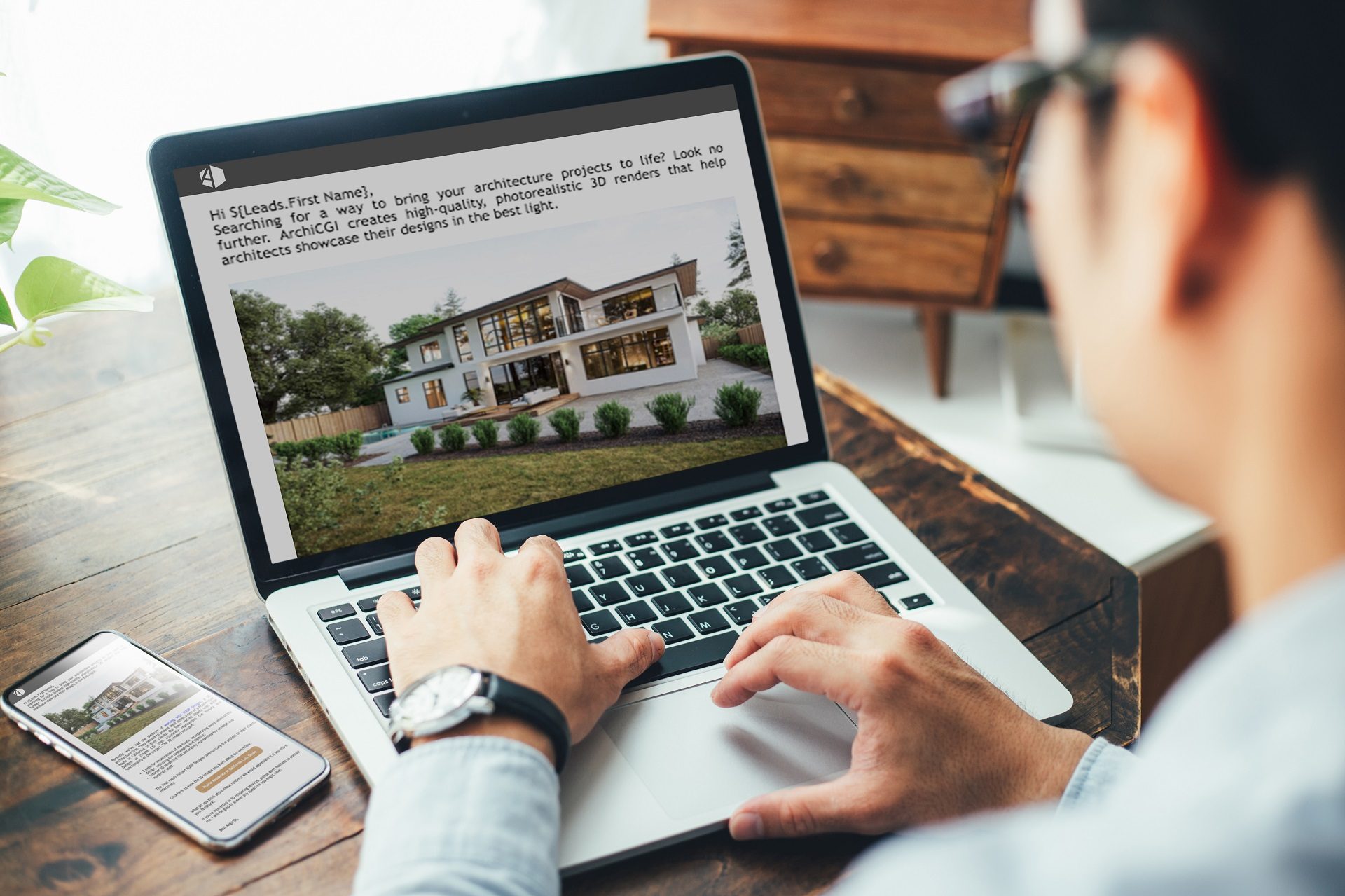
Building a proper list is the first step in successful email marketing for architects. This list is not just about staying in touch with potential clients, industry peers, and interested folks. It’s an opportunity to establish yourself as an expert. With a healthy email list, you can efficiently nurture client relationships.
To get new interested subscribers, add sign-up forms or lead magnets to your website and social media. Industry-specific and networking events are the other two channels that can help you expand your audience.
Building a strong email list requires ongoing maintenance. Regularly clean your list to ensure you’re sending emails to engaged recipients. This will improve your deliverability rate. Remove inactive or uninterested subscribers to keep your list thriving. Go for quality, not quantity. You might even consider implementing a double opt-in process. This way, you will be sure your subscribers actually want to receive your letters.
#2. Create High-Quality Content

The most important part of email marketing is providing valuable content for your target audience. It might be exclusive access to some architectural resources, an overview of industry trends, a curated newsletter, a guide, and so on. In any case, you need to offer something compelling to get people to subscribe.
To create engaging content for your target audience, you should understand their needs and pain points. Tailor your copy to address their challenges and provide practical solutions. Use a conversational tone to make your text relatable and easy to read.
It’s also vital to incorporate high-quality visuals, preferably 3D rendering for marketing agencies. And don’t forget to include a clear call to action. You should guide your recipients to take the next steps. Suggest they take a look at your portfolio or schedule a consultation.
Elevate your exterior design project with photorealistic 3D visuals that help clients confidently approve your proposals.
Need some inspiration? Here are a few examples of types of content that you can use in email marketing for architects.
- Case studies. Highlight your design process, the challenges faced, and the innovative solutions implemented. For example, you can use 3D rendering and photography to show the project before and after completion;
- Unique educational resources, such as e-books, guides, or tips for homeowners;
- Updates about your firm’s packages and pricing.
A great idea is to make use of storytelling. Share stories that demonstrate the impact of your designs on people’s lives. This way, you can create an emotional connection that resonates with your audience.
#3. Segment and Personalize Your Emails

Segmentation and personalization do different jobs in email marketing for architects. The first sorts the audience; the second tailors the message to a group or a single reader. Practical segments for a firm:
- developers, homeowners, commercial clients, contractors, past customers, and industry partners as base categories;
- project type, location, budget range, service interest, relationship stage, and prior engagement as refining criteria.
Want to learn how much your project costs? See how we evaluate 3D rendering projects

Content follows the split: homeowners get residential case studies, a property company receives development material, and technical insights go to professional partners. Personalization starts with the name and extends to project examples, imagery, subject lines, calls to action, and service recommendations. Gather the data for this through enquiry forms, consultations, downloads, event registrations, and reactions to earlier letters. Keep the scheme manageable: a few categories the firm can feed with fresh content on a steady schedule. Sorted this way, a list becomes a set of parallel conversations, and every subscriber sees work that relates to their own plans.
#4. Use Email Automation

Automation occupies a specific niche in email marketing for architects. A newsletter goes out on a calendar; an automated message waits until a recipient does something, then reacts to it. This fits the pace of an architecture deal well, since weeks can separate the first inquiry from a signed contract, and each stage calls for its own message at its own moment. Typical sequences:
- a portfolio or guide download starts a series with related case studies and service details;
- a consultation request triggers preparation notes and a reminder;
- a proposal that stays open past a set date prompts a measured follow-up;
- project completion launches feedback, referral, and future-service messages;
- a long-quiet former client gets a re-engagement letter matched to their past commission.
Plan every step with a defined trigger, delay, purpose, call to action, and exit condition. Set handoff rules as well: once someone replies, books a meeting, or needs individual attention, the sequence stops and a person takes over. Review engagement periodically, remove steps that go unread, and cap overall frequency. Run this way, follow-up stays consistent while each contact is addressed personally. Mailchimp, Brevo, and Zoho Campaigns all support these scenarios.
Showcase your architectural project with photorealistic CGI powered by modern AI-assisted workflows
#5. Ensure Regular and Consistent Communication

Consistency in email marketing for architects works best when it tracks the firm’s own business cycle rather than a slot on the calendar. Frequency should follow what a practice can genuinely offer: current projects, fresh insight, and the hours the team has to write. An editorial calendar makes this concrete:
- milestones on live projects and studio news;
- awards, competition results, and speaking dates;
- events the firm hosts or attends;
- research and short studies worth sharing;
- service updates and packaged offerings.
Recurring themes let readers anticipate the kind of value each issue carries. Presentation holds steady in parallel: one tone, a familiar sender name, a stable visual identity, a repeated structure, and consistent calls to action. Send only when there is something worth reading, and give subscribers an easy way to adjust their preferences. Frequency itself becomes a variable to tune against engagement figures, examined in detail further down. Kept up this way, a practice stays present in a reader’s mind until the day a fitting project or referral arrives.
#6. Keep Track of Metrics and Adjust Your Tactic

Key Performance Indicators are essential in assessing the effectiveness of your email marketing. They provide measurable metrics that reflect the performance and impact of your campaigns. By understanding and tracking KPIs, you gain valuable insights into how you perform. You can identify whether your marketing efforts align with your overarching goals.
What metrics should you pay attention to? Open, click-through, conversion, and unsubscribe rates are common KPIs to track. The open rate indicates the percentage of recipients who opened your email. In turn, the click-through rate measures the proportion of recipients who clicked on links within your email. The conversion rate reflects the percentage of those who took the action you wanted. For example, they requested a consultation. Lastly, the unsubscribe rate gives insights into the number of those who opted out of your email list. By monitoring these metrics, one can assess the engagement, impact, and overall success of email marketing for architects.
Measuring success is only the first step though. The next one is to continuously refine and adjust your email marketing strategy based on the data you gather. You should analyze the performance of your campaigns and identify areas that need improvement. If your open rates are low, consider optimizing your subject lines and preview text to grab attention. If click-through rates are lacking, focus on crafting more compelling and relevant content.
Test different aspects like visuals, CTAs, or sending times to see what resonates best with your audience. Ask for feedback from your subscribers through surveys or encourage direct communication. You should understand their preferences and tailor your strategy to them. Remember, refining your strategy is an ongoing process. It allows you to continually improve and deliver greater value to your audience. Which, in turn, helps to get more clients.
Get your project estimated in just 1 hour - fill out this brief!
Email marketing for architects can be a powerful promotional tool. If everything’s done right, you’ll establish a direct line of communication with prospective clients and will keep yourself fresh in the minds of the former ones.
Email works best as part of a wider system. Our guide to architectural marketing shows where newsletters sit among the other nine channels, and 3D rendering for architects explains how the visuals you attach are produced. For subject lines and content ideas, content marketing for architects covers what to write about between project announcements.
Successful email marketing requires combining the power of text and visuals. So, if you’re looking for real estate 3D rendering services to ensure you always have enough high-quality images, look no further! Contact us at ArchiCGI today to leverage the power of 3D visualization for a reasonable price.
Related reading: digital marketing for architecture firms. Nataly Cher Nataly's ambitious nature and creativity play a key role in her ability to create engaging content and highly successful targeted campaigns. Outside of the office, Nataly indulges her love of photography and plays with her joyful Jack Russel terrier, Mario.

Senior Social Media & Email Marketer