


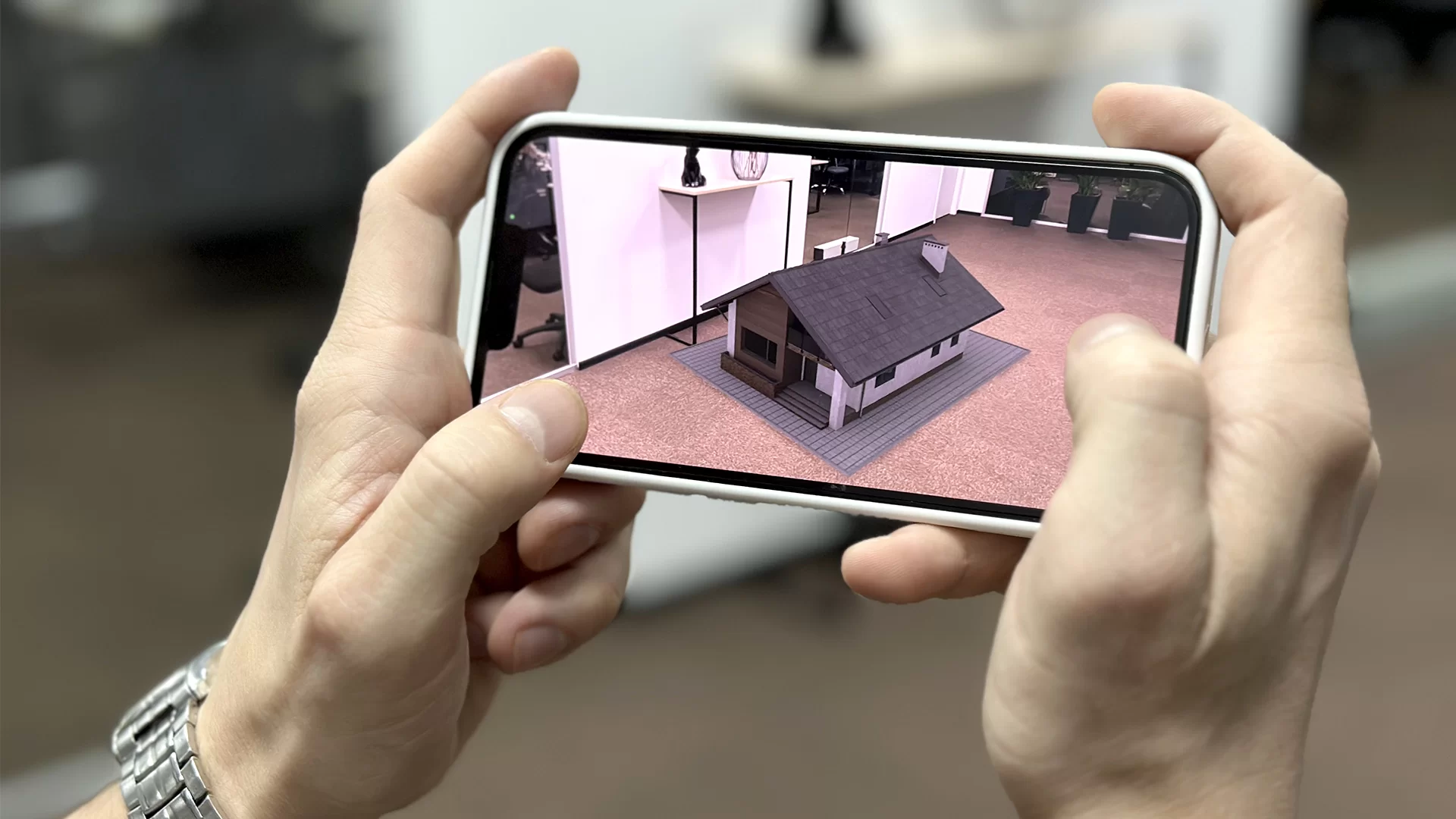
Using augmented reality for architecture is not the most common practice. While AR technology is quite familiar to us in the context of online shopping and entertainment, its use in the architecture industry is rather a new thing. But that doesn’t mean you cannot benefit from it. In fact, this kind of CGI has a lot to offer.
In this article, we will show you how architects can use augmented reality to enhance various aspects of their work. You will also see some examples of AR-ready 3D models created by our architectural visualization studio. And who knows — maybe it’s just the thing you were looking for to freshen up your project presentations. Let’s take a look!
What Is Augmented Reality?
Augmented reality is a technology that allows one to view computer-generated 3D objects in a real-life environment. AR is available on smartphones and tablets. All it requires is the use of the device’s camera and an optimized 3D model in a suitable format. For iOS, it’s USDZ, and for Android — GLB. You just need to open a link to the model, and you will see the 3D object right in front of you through the camera of your device.
How Is AR Used in Architecture?
The main use of augmented reality in architecture is for project presentations, where you can showcase a realistic 3D model of your building concept in an interactive way. It works great for presentations you do for your clients, as AR allows them to examine the design from any angle, and zoom in and out on it.
Ensure your exterior design project leaves a lasting impression and takes your clients’ breath away with stunning visuals.
At the same time, augmented reality can be a valuable collaboration tool for when you work on a project with your team. Namely, it can be quicker and easier to view the entire concept in AR and identify any issues that might need improvement.
Below, you can see an AR-ready 3D house exterior created by our CG artists on top of a 3D virtual tour rendering. It is done in greyscale, which allows one to focus purely on the architecture of the building. This kind of visual can come in handy at the earlier stages of the design process when changes are still being made to the size and shape of the structure.

Scan QR code to view this model in AR
And here, we created a textured version of the same house. This option is meant to help finalize the selection of exterior materials.

Scan QR code to view this model in AR
Top 5 Augmented Reality Apps Used in Architecture
Architects are increasingly using Augmented Reality apps to review designs in context, communicate ideas to clients, and reduce guesswork during planning and construction. Instead of relying only on drawings or static renders, AR tools allow teams to place digital models into real spaces and evaluate scale, proportions, and design decisions in real time. Below are five Augmented Reality Apps that are most commonly used in architecture today, based on their practical value, accessibility, and relevance to professional workflows.

#1. ARki
Building + Room Planner
Available on: iOS (iPhone, iPad, Mac, Apple Vision)
Price (USA App Store):
- Free to download with limited features
- ARki Pro (annual): approx $219.99/year
- ARki Pro (monthly): around $19.49/month (may vary by device and region)
ARki is a 3D design and AR room planner that lets both casual users and professionals design, visualize, and walk through interiors and architectural plans in augmented reality. It combines room planning tools with AR visualization and supports complex 3D model imports.
Key Features:
Free/basic level:
- Draw and edit 2D/3D room layouts with simple tools
- LiDAR or manual input for instant floor plans
- Library of 1,000+ interior models for furniture and decor
- AR visualization to place and view designs in real space
- Sync and share projects across devices
ARki Pro (paid):
- Import 3D models in FBX and GLB formats from software like SketchUp, Revit, Blender, AutoCAD, etc.
- Mixed reality (AR) overlays for on-site full-scale viewing
- Accurate 1:1 scaling of designs in AR
- Real-time lighting and shadow simulation
- Offline storage of models on the device
- Annotating models and interactive material options
- Unlimited projects and advanced collaboration tools
Professional applications
ARki streamlines interior design and architectural visualization by letting users quickly plan, adjust, and present 3D projects with AR walkthroughs before building or decorating. It suits homeowners, designers, and architects alike.
#2. Morpholio Trace Pro

Available on: iOS
Price (USA):
-
Free download with limited features
-
Subscription plans (US App Store):
- Essentials: from $4.99/year
- Plus: around $9.99/year
- Pro: around $29.99/year
Monthly plans are also available. Pricing may vary by device
Website: https://www.morpholioapps.com/trace
Next in our selection of top augmented reality apps, we have Morpholio Trace Pro. It’s an all-in-one mobile CAD application with tons of features, including AR. Namely, there are two AR-powered tools: AR Perspective Finder and AR SketchWalk.
AR Perspective Finder is a tool that makes architectural drafting on mobile much easier. It uses the built-in AR capabilities of an iPhone or iPad camera to scan a space and create accurate virtual perspective grids for sketching with Apple Pencil. This way, you can produce precise drawings quickly, even on the go. For projects that go beyond quick sketches and require detailed plans of woodwork or cabinetry, accuracy can be ensured with a professional millwork drafting service.
Take your design presentation to a new level with interior rendering
In its turn, the AR SketchWalk tool allows you to virtually project your architectural CAD drawings onto a real environment at a 1:1 scale. You can choose to view either floor plans alone or floor plans together with elevations. Then, you can even take an immersive walk through your future building visualized in augmented reality. It’s a great way to present design concepts to clients or your project team. Overall, SketchWalk is by far the most unique AR feature for architects, as no other apps on our list have anything similar.
#3. Magicplan

Available on: iOS, Android
Price:
Starts at:
- $9.99/month after a free trial limited to 2 projects
- $8.33/year after a free trial limited to 2 projects
Website: https://magicplan.app
Out of all the augmented reality apps for architectural drafting, Magicplan is one of the best for producing floor plans. It lets you scan a room with a smartphone or tablet camera and automatically generate crisp, accurate floor plans in 2D or 3D. This makes it easy to create high-quality interior drawings to share with your team, clients, or contractors. These plans can also serve as references for photorealistic 3D interior design visualization.
You can then use these floor plans to get a CGI product that combines the precision of a blueprint with the visual impact of a 3D render. With a floor plan rendering service, it becomes possible to showcase both the space layout and the interior design.
#4. RoomScan Pro

Available on: iOS
Price: $8.49/year after a 7-day free trial
Website: https://www.locometric.com/roomscan
Unlike most augmented reality apps, RoomScan Pro offers three ways to create floor plans, including AR scanning. It allows you to capture both interiors and exteriors of buildings and automatically generates 2D or 3D plans. With RoomScan Pro, it’s also possible to add colors and annotations to drawings to make them easier to read. Plus, you can then show 3D plans to your clients or team members in augmented reality mode. This is ultra informative and helpful for establishing communication.
For advertising-quality imagery, however, the images will not be a good fit. So consider interior 3D rendering services if you want photorealism, accuracy and visual impact.
#5. Sun Seeker

Available on: iOS, Android
Price: One-time purchase of $9.99
Website: https://www.ozpda.com/apps
Last but not least, we have Sun Seeker on our list of the top augmented reality apps. It allows you to view the path of the sun in AR at a particular location. Moreover, you can see the sun’s exact position at different times of the day and throughout the year. This way, you can visualize and analyze the solar exposure and shade your future building will be getting. That will help you optimize your design to make it more convenient and sustainable.
Difference between Augmented Reality and Virtual Reality
Virtual reality is an immersive technology that places users inside a fully digital environment, detached from the physical world. The experience is created using computer generated spaces that can replicate real locations or represent conceptual designs, allowing users to move through them and interact with objects in real time. In contrast, augmented reality enhances the existing environment by overlaying digital elements onto real world surroundings rather than replacing them.
The technological difference between VR and AR lies primarily in hardware and system requirements. Virtual reality relies on dedicated equipment such as head mounted displays, motion tracking sensors, and controllers to deliver full immersion and spatial interaction. Augmented reality, on the other hand, typically operates through smartphones, tablets, or lightweight headsets, making it more accessible but less immersive.
In terms of use, virtual reality is commonly applied in architecture and real estate for immersive presentations, collaborative design reviews, and spatial validation, enabling teams and stakeholders to experience scale, layout, materials, lighting, and atmosphere before construction begins. Augmented reality is more often used to visualize digital models within real environments, supporting on site assessments, contextual visualization, and early decision making without removing users from the physical space.
Schedule a free demo of 3D solutions for your business
As you can see, there are some real benefits to using augmented reality for architecture design process and presentations. So, if you want to try something new to streamline and enhance your workflow, you should definitely consider tapping into AR technology.
Looking for full-range 3D services? Contact us at ArchiCGI and book a free consultation with one of our client managers! We’ll answer any questions you might have and help you find out what solutions will be best for your architecture business.

Ana Wayne
Content Writer, Copywriter
Ana is a content writer for ArchiCGI. She has a passion for design and architecture - and for talking about it. Outside of work, she is a fan of sci-fi movies and a street food connoisseur.