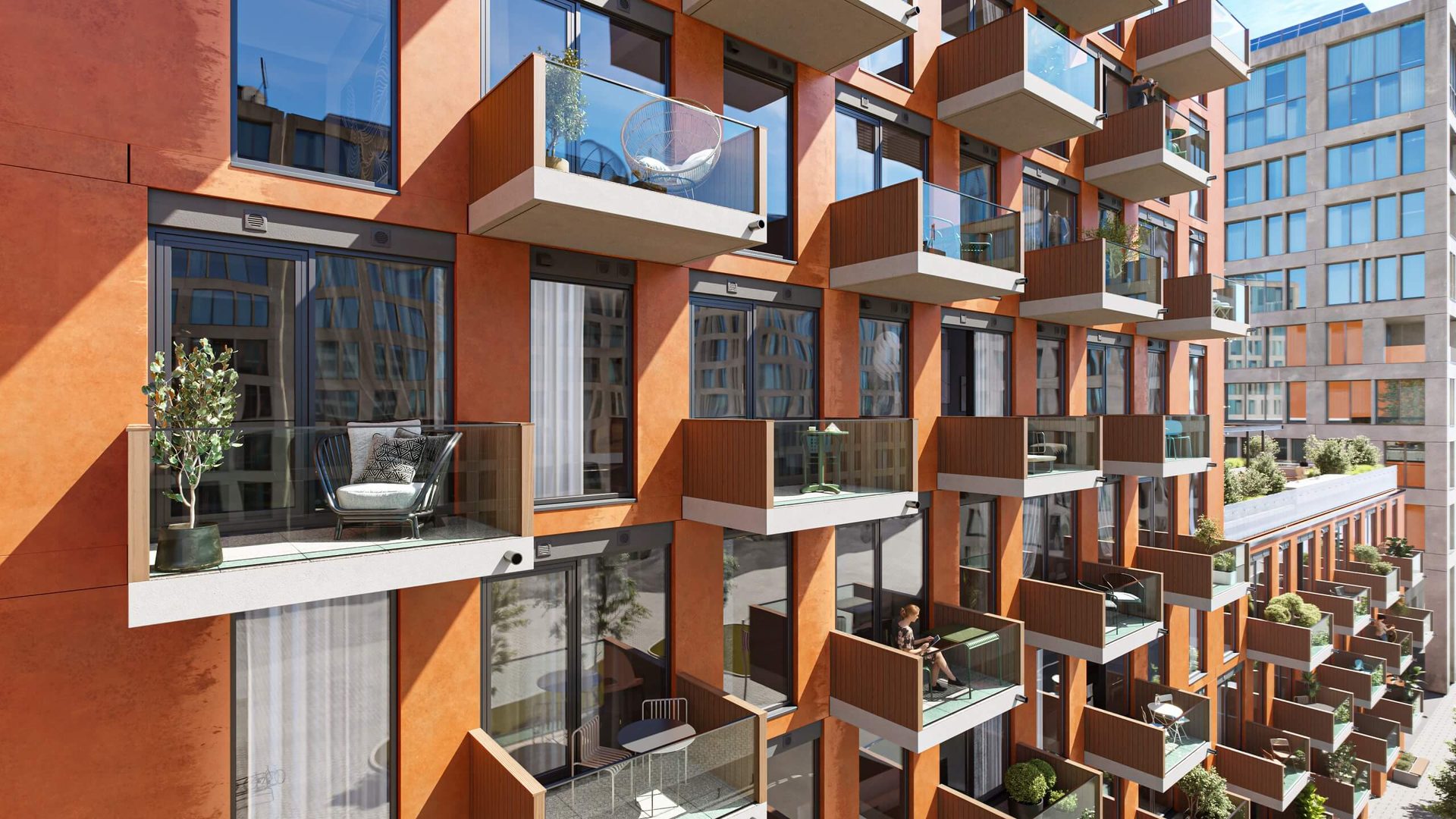
Exterior renders are the first thing a client sees in a pitch and the workhorse of real estate marketing, so exterior 3D rendering cost is now a standard line item in architects’ presentational budgets. This article covers exteriors only: for interior, animation, and virtual tour pricing, see the full 3D rendering cost guide. The benefits of a photoreal architectural visualization are obvious — a client gets a clear view of the project as if it was already built, and the picture looks more impressive and convincing than a hand-drawn sketch. As a result, an architect delivers their vision more efficiently and gets more enthusiastic approval.
An architectural 3D rendering company will do a visualization project of any complexity with any level of detail. Common sense says 3D visualization cost varies proportionally to the amount of work, but one question remains open: what exactly forms the 3D rendering price?
With this knowledge, architects understand exactly what they pay for. This way, they gain more control of the price and the way the visualization affects customers. And when in need to reduce the cost, a well-informed architect can do so by removing a few non-critical features. So today, we are sharing with you six key factors affecting the exterior rendering services cost that will act as a road map for you.
3D Exterior Rendering Price Range
How much does exterior 3D rendering cost? At ArchiCGI, a residential exterior rendering starts from $600 per image, while commercial and multifamily exteriors start from $900. Aerial and urban-scale views start from $1,200. Each price includes three review rounds and delivery in about three days. Extra views of the same project are discounted, high-volume clients can get up to 40% off, and single-family developers ordering 10 or more homes a month pay $360 per home. The final price depends on the six factors described below. For an exact quote tailored to your project, see ArchiCGI’s price list or fill out a project brief.
#1. Brief Influences the Exterior Render Price
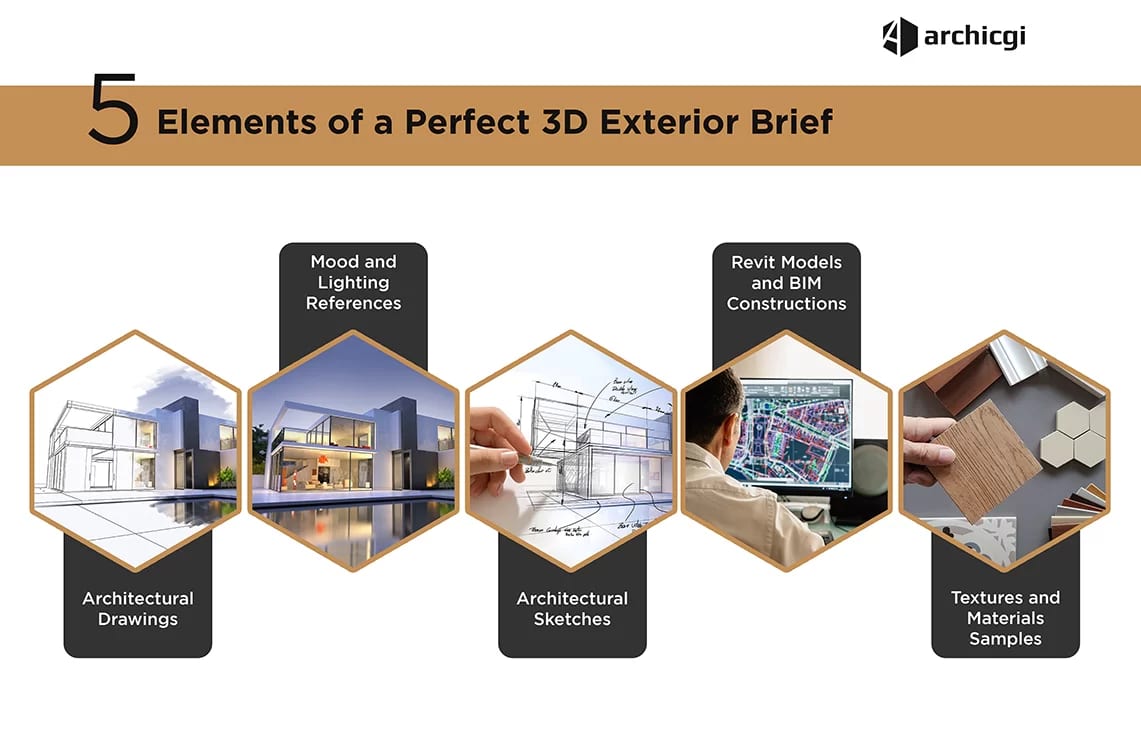
A project brief can greatly affect exterior 3D rendering cost. Why so? That’s because, with detailed drawings and many visual references, 3D artists understand the concept of an architect’s design perfectly from the very beginning of work. Which is exactly why they become able to recreate it in exterior CGI with the greatest precision possible. This means there will be no need for many rounds of corrections that could increase the cost. Moreover, a comprehensive brief also speeds up the workflow. With a detailed assignment, a CGI visualization team can complete an exterior 3D rendering project up to 30% faster.
So what exactly does a comprehensive brief look like? A strong starting point typically includes architectural drawings (floor plans, elevations, sections), material specifications with finishes and colors, and visual references like mood boards or inspiration images. The more detail you can share upfront, the fewer assumptions 3D artists need to make — and fewer assumptions mean fewer revision rounds.
In practice, we see a clear pattern: projects with detailed briefs typically stay within the standard 3 revision rounds included in the price. When information is missing or unclear, additional corrections may be needed at the standard hourly rate. Even a 30-minute investment in gathering proper reference materials can easily save $200-400 in revisions down the line.
#2. Scale Defines the Exterior Rendering Cost
Depending on how much area a building is going to occupy and whether it is a small cottage or a multi-story complex, a team of 3D artists will be modeling it for several days or just a few hours. Exterior visualizations come in all shapes and sizes. They can show any type of architectural object and range from a cozy cottage to a stylish townhouse rendering. Each of them needs separate consideration when it comes to the exterior rendering price.
The scale of your project directly determines how much 3D modeling work is required — and therefore the exterior rendering cost. A compact single-family home takes a few hours to model, while a high-rise complex might take days. Here’s how different project types typically compare:
| Project Type | Complexity | Typical Starting Price |
|---|---|---|
| Cottage / Small house | Low | from $600 |
| Single-family home | Low-Medium | from $600 |
| Townhouse / Duplex | Medium | from $900 |
| Multifamily | Medium-High | from $900 |
| Commercial | Medium-High | from $900 |
| High-rise / Skyscraper | High | from $1,200+ |
| Mixed-use complex | High | from $1,200+ |
The difference isn’t just about building height — it’s about the number of unique architectural elements, facade details, and surrounding context that need to be modeled. An ornate 2-story villa might cost more than a minimalist 10-story tower simply because of detail density.
#3. Environment Affects 3D Exterior Rendering Prices
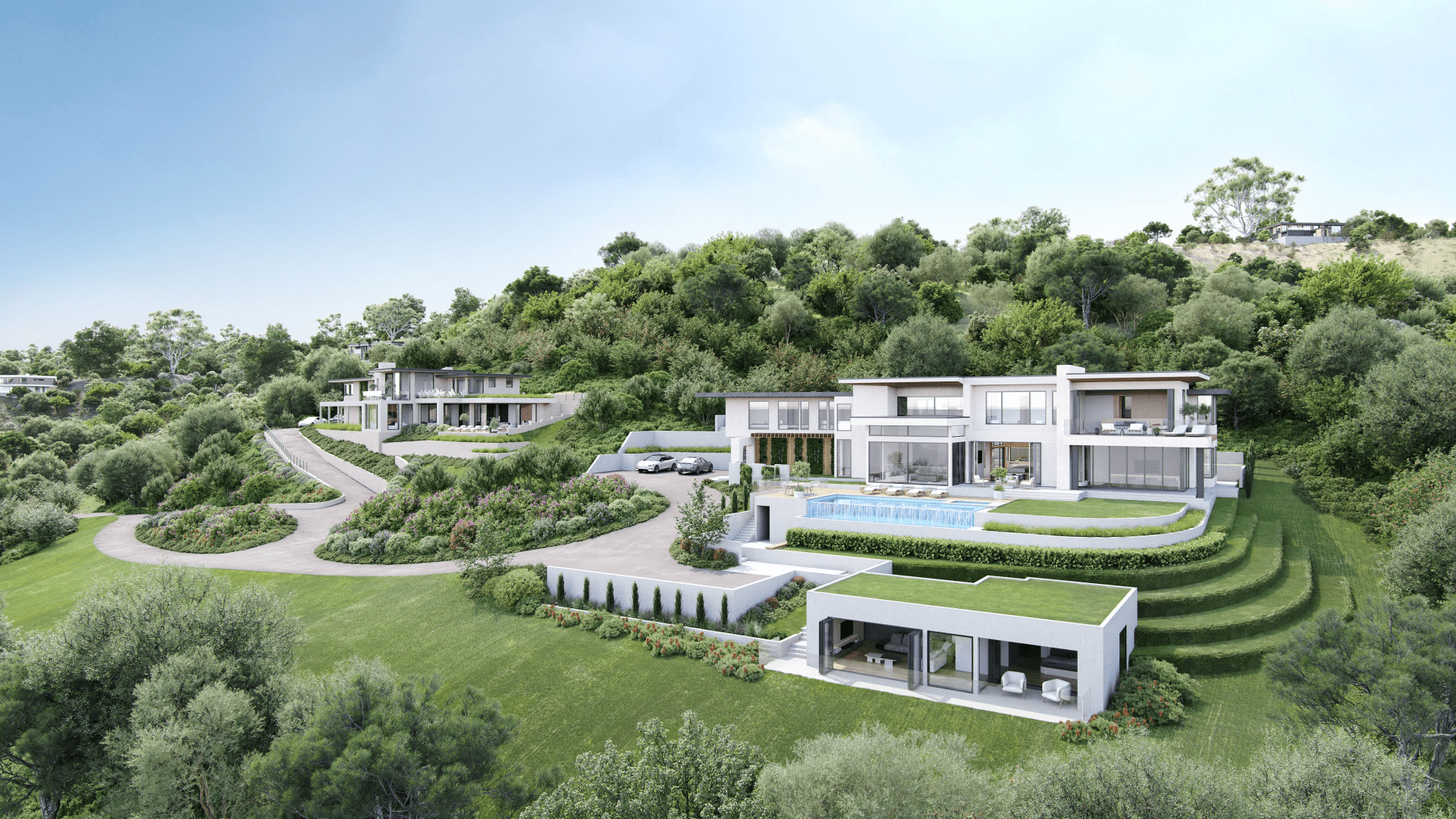
Along with the project size, the background and environment also make a difference to the exterior 3D rendering cost. The more work a 3D artist has to do, the higher is the price. Here are three main types of environment arranged by complexity:
- A photo is the lowest-cost surrounding ever available. It is excellent for demonstrating the difference the project is going to make. A photo can be found on the Web, taken from the ground or a drone. The resulting render looks excellent, and it takes less time to create. The technique used to combine 3D rendering scene with a photo is called photo montage rendering.
- Ghost buildings in the world of 3D visualization are diaphanous low-poly models. Easy and fast to create, they put a project into an unobtrusive context where nothing distracts from the architect’s vision.
- Photoreal environment rendering is able to mesmerize the audience. Whether it is a breathtaking landscape or an elaborated neighborhood of lifelike buildings, the most presentable surrounding will accompany the project. Obviously, such a background requires an extra amount of modeling and texturing work, and it results in the highest wow factor. Naturally, architects often decide for a realistic surrounding: the presentation absorbs viewers, so the price pays off by far.
To give you a concrete sense of price impact: a photo montage background adds minimal cost since the surrounding already exists as a photograph. Ghost buildings require some additional modeling but remain relatively affordable. A fully photoreal environment with detailed neighboring buildings, landscaping, and street elements involves significantly more work — but the immersive result often justifies this investment for flagship marketing visuals.
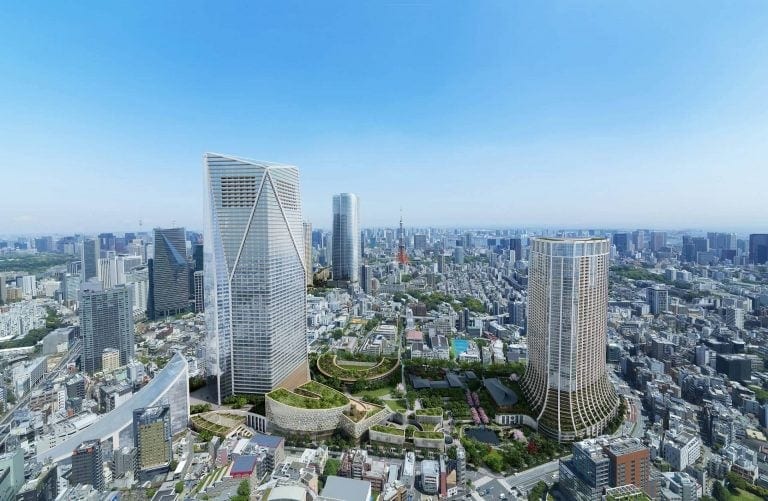
See how aerial rendering reveals a project’s scale and impact
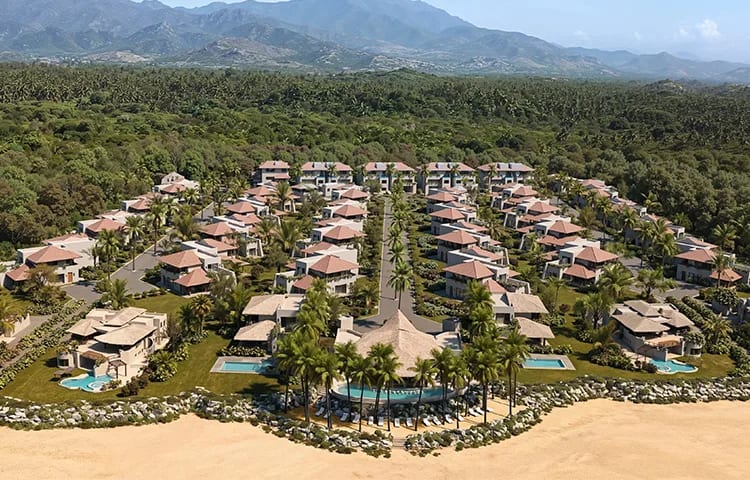
Choose based on your presentation goals: photo montage works great for planning approvals where context matters, ghost buildings suit conceptual presentations, and full photoreal environments shine in sales materials where emotional impact drives decisions.
As you see the environment has an impact on the exterior 3D rendering cost, and there’s always an option for various project goals and budgets. For architects and designers to choose the best 3D solutions that will do the job and stay right on budget, we’ve revealed a few secrets on how to save money while getting high-quality CGI rendering.
#4. Exterior 3D Rendering Cost Depends on Architectural Style
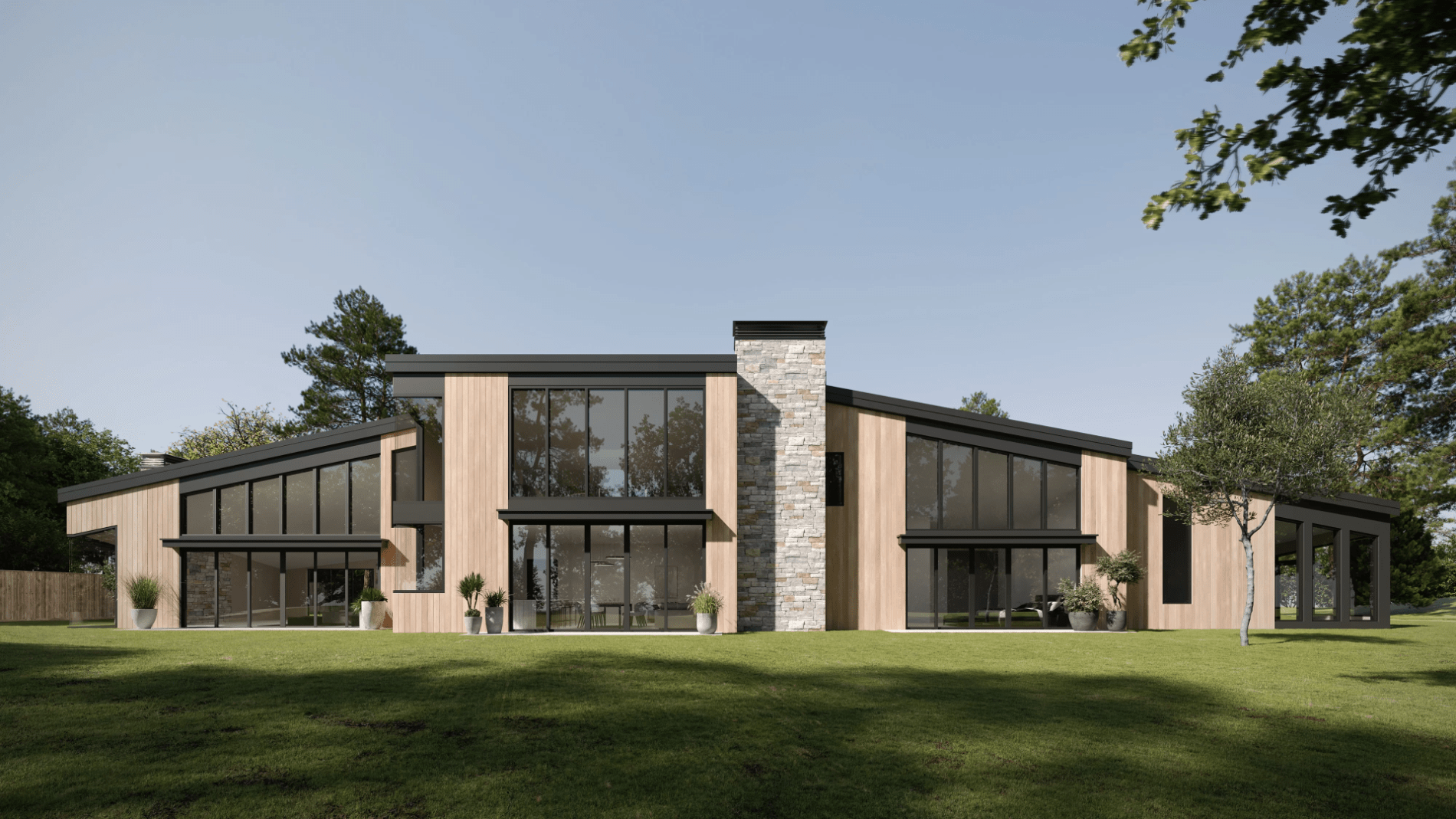
The more complex forms and decorations the artists use, the more work a 3D visualization studio has to do. Although the style doesn’t determine the number of details directly, some tendencies are obvious. Generally speaking, Modernist architecture is among the easiest to model. The more detailed High-Tech and Classicism tend to be more laborious, followed by Baroque. As a rule, Neo-Gothic needs even more time and effort due to its abundant ornamentation. In this way, aesthetics influence the cost, and there are ways to save on 3D rendering without losing quality.
Why the price difference? It comes down to modeling hours. A Modernist facade with clean geometric volumes and flat surfaces might take 4-6 hours to model. A Classical building with columns, cornices, and symmetrical ornaments doubles that time. Baroque and Neo-Gothic — with their intricate sculptural details, tracery, and decorative elements — can require 15-20+ hours of detailed modeling work.
Here’s a practical comparison: imagine two buildings of identical size. A Modernist glass-and-concrete office building has perhaps 20-30 unique geometric elements to model. A Neo-Gothic church of the same footprint might have 200+ unique decorative elements — gargoyles, pointed arches, ribbed vaults, finials. Each element requires individual modeling, texturing, and positioning. The style you’re visualizing directly translates to labor hours and, consequently, exterior 3D rendering cost.
#5. The Number of Views Affects the Exterior Rendering Price
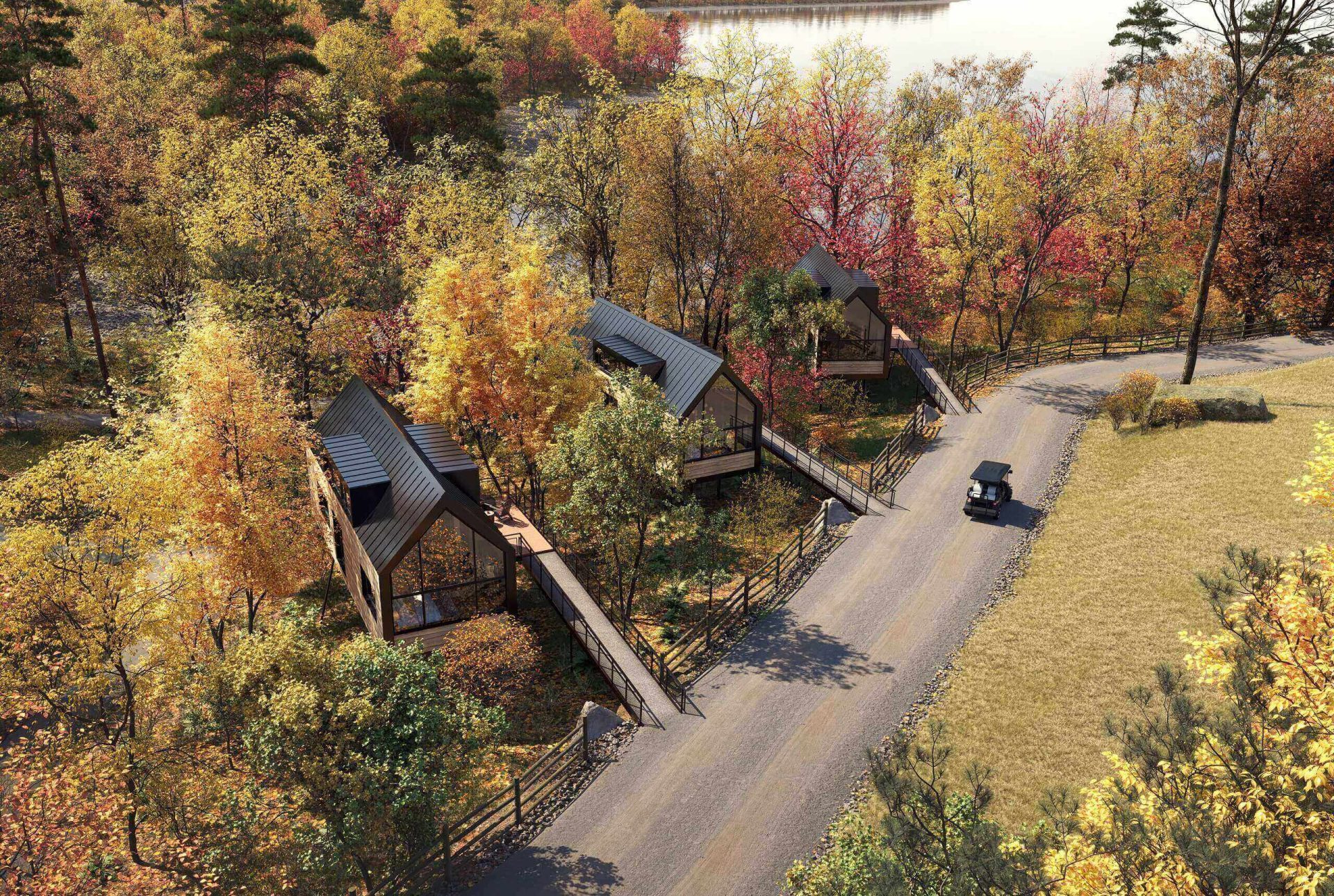
Different buildings look best from different perspectives, and some architectural designs need viewing from several angles to show all their splendor.
A front or angle view is a good pick for a balcony or porch. The angle view requires some surrounding, resulting in a higher exterior 3D rendering cost. For the same reason, the general view contributes more to the rendering cost, followed by the bird view, which embraces the largest area. While the general view is the most common choice in exterior 3D rendering, several bird’s-eye perspectives or a single bird-view animation deliver the advantages of the design more effectively as they show it from multiple viewpoints. Also, it’s more impressive as it contrasts with our everyday experience where there’s no flight or glide.
Here’s how different view types compare in terms of scope and price impact:
| View Type | What It Shows | Best For |
|---|---|---|
| Front view | Building facade straight-on | Elevation presentations, planning submissions |
| Angle/Corner view | Two facades + some depth | Marketing materials, general presentations |
| General view | Full building in context | Sales brochures, website hero images |
| Aerial/Bird's-eye | Building + surrounding area from above | Master plans, large developments, site context |
When should you invest in multiple angles? For residential sales, 2-3 angles (front, corner, and one lifestyle shot) typically cover all marketing needs. For commercial developments or master-planned communities, aerial views become essential to show the project’s relationship to its surroundings. Large developments often benefit from a combination: aerial for overview, ground-level angles for human-scale appeal.
The windows may shine softly, reflect the neighborhood, or cast light on the ground. They can be covered with blinds or left to reveal the interior if you want. The latter option adds value to your project. It’s not just a house now. It’s a home to live in! On the flip side, interior elements increase the amount of modeling work. This will increase the 3D visualization cost.
You should keep this aspect in mind before starting the project. This type of work requires more expertise. Namely, you will need the services of a 3D exterior and 3D interior renderings company.
#6. Post-Production Adds Value to Exterior 3D Rendering
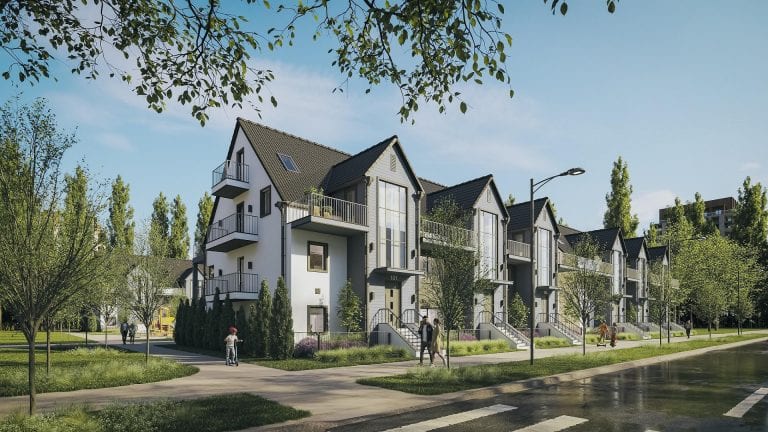
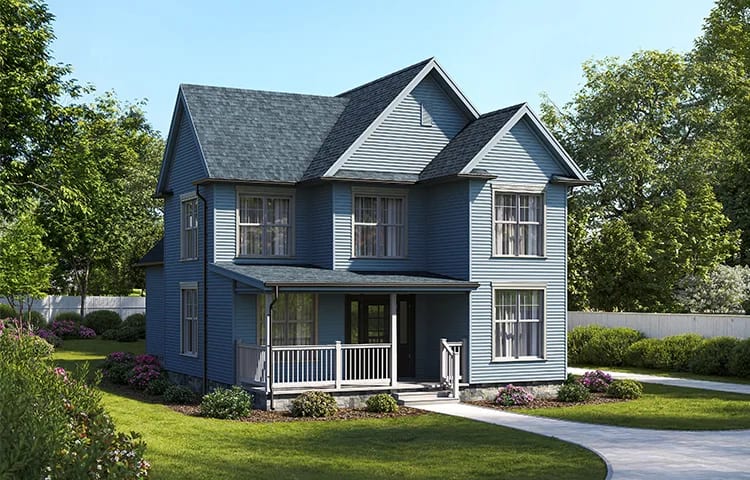
The main purpose of the post-production stage is to make a render more organic and realistic. Its minuteness also results in variations of architectural 3D rendering prices. Details such as people reading, pets playing, and cars driving into the garage increase the cost, but the effect they have is tremendous: the picture lives its own life, and the client wants to belong there. Different weather conditions make the visualization atmosphere solemn or playful, funny or dramatic. The picture above radiates calmness and peacefulness due to the cool weather and the people strolling around and socializing.
Empower off-plan sales with detailed 3D visualizations
What exactly goes into post-production? Common elements include:
- People and lifestyle elements: Figures walking, sitting in cafes, children playing — these transform a render from “building” to “place to live”
- Vehicles: Parked cars, moving traffic, bicycles add urban realism
- Vegetation: Trees, shrubs, grass, flower beds — especially important for landscape-focused projects
- Weather and atmosphere: Golden hour lighting, dramatic clouds, rain reflections, snow — each creates a distinct mood
- Motion blur and depth of field: Photographic effects that make renders feel like real photography
Basic post-production (standard sky, a few people, basic vegetation) is typically included in the base price. Premium post-production — custom atmospheric effects, dozens of lifestyle figures, elaborate landscaping, or specific seasonal conditions — involves additional work and will affect the final cost. For marketing hero images where emotional impact matters, this investment typically pays off in client response.
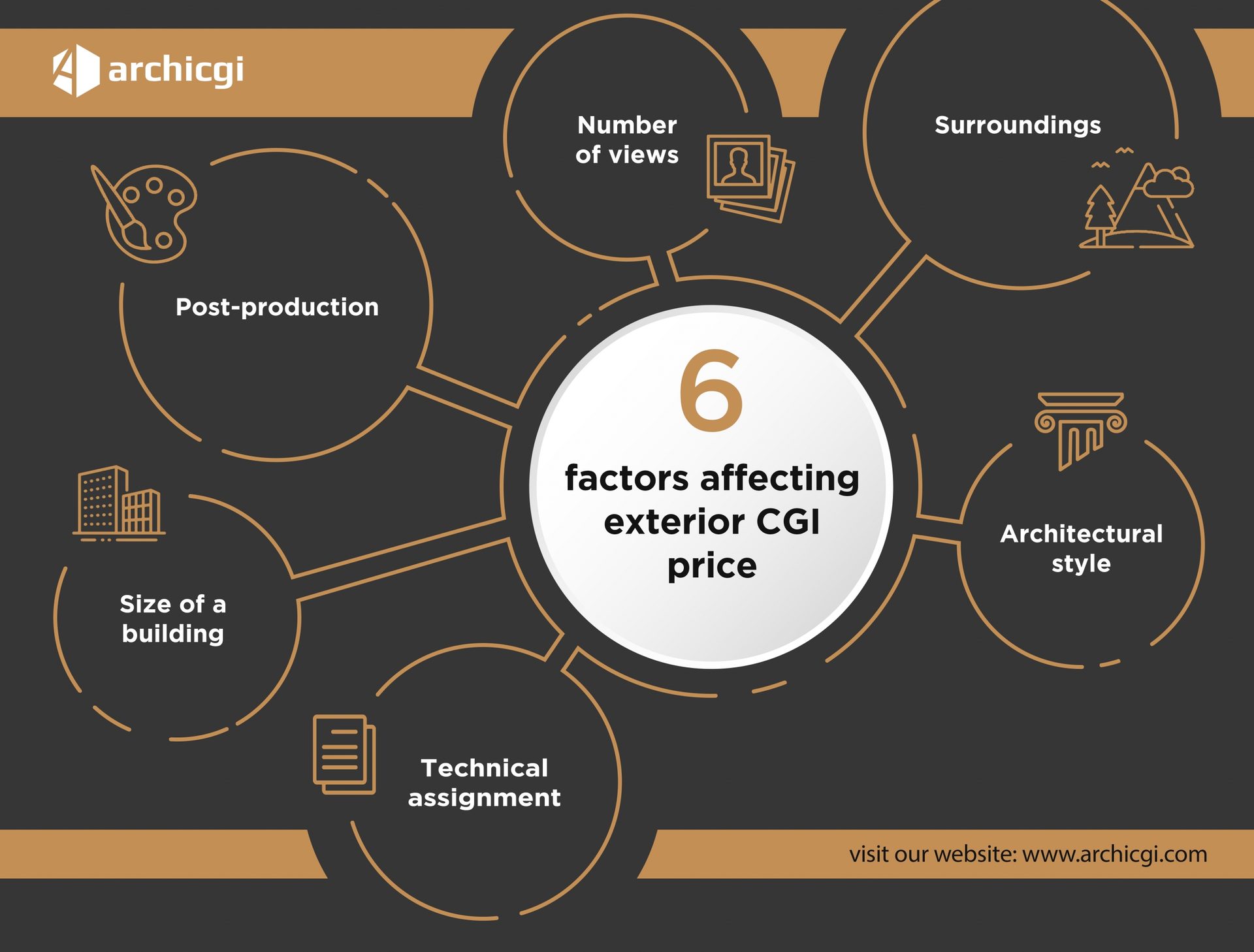
As you can see, the exterior 3D rendering cost is affected mainly by the scope of a brief, the size and style of the project, the way the neighborhood is created, the types and number of views, and the depth of post-processing. Only the geometry of the building is predefined, while the rest of the factors are within your control.
Want to empower your presentations? Contact the architectural animation company ArchiCGI. We will create 3D videos and stills that will impress your clients.
Immerse clients into your projects with realistic 3D animations
To start your own exterior visualization project, contact ArchiCGI and get high-quality photoreal renderings able to impress clients and investors.

Irma Prus
Content Writer, Copywriter
Irma writes articles and marketing copy for ArchiCGI. Her dream is that more people discover the power of CGI for architecture. Irma is into neuromarketing, ruby chocolate and Doctor Who series.